Pullulanase for glucose-rich syrup conversion
Glucose and dextrose syrup production depends on how completely liquefied starch can be converted into fermentable and crystallizable sugars. After liquefaction, amylopectin-derived dextrins still contain alpha-1,6 branch points. Those branches restrict access for saccharifying enzymes and can leave residual branched oligosaccharides in the syrup stream.
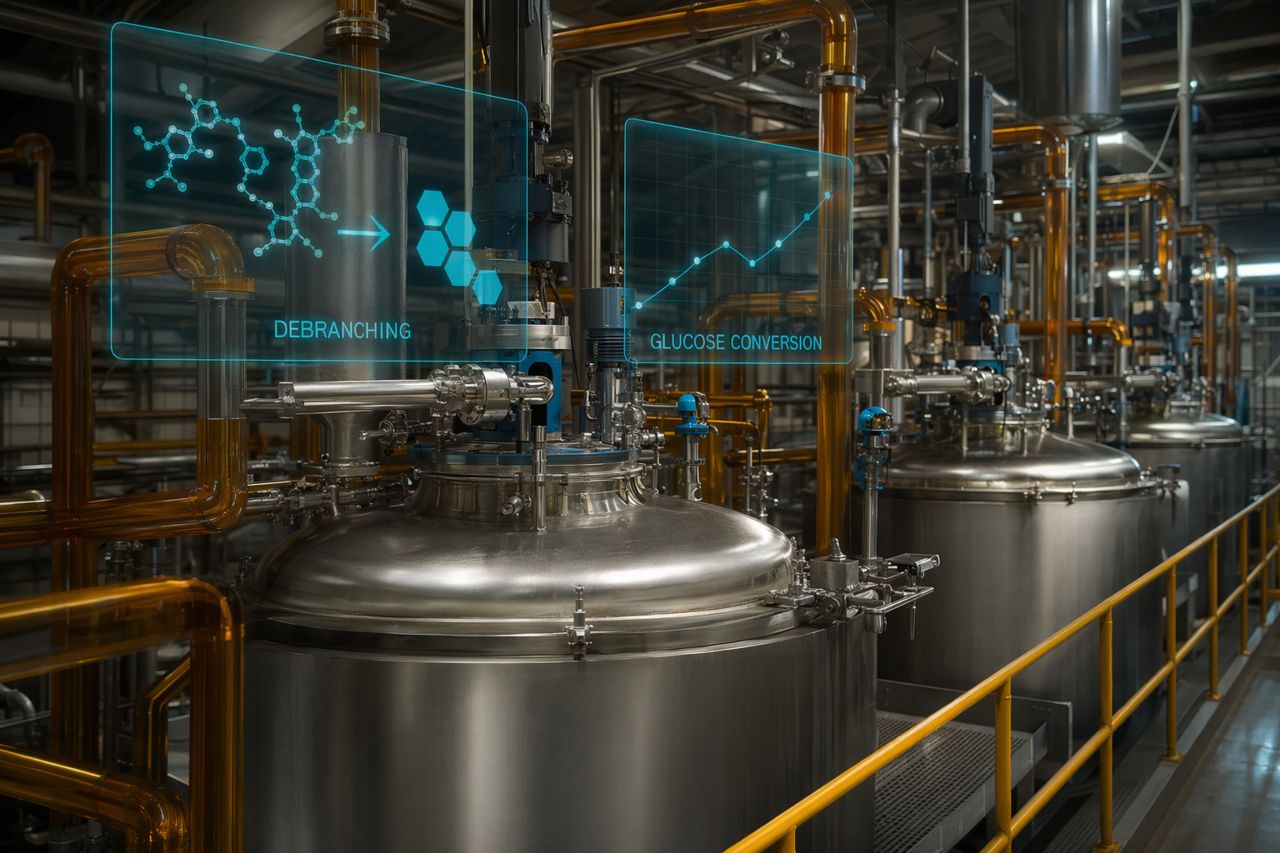
Pullulanase (Pullulan 6-alpha-glucanohydrolase) is used to debranch those dextrins. By hydrolyzing alpha-1,6 linkages, it opens the substrate for glucoamylase and other saccharifying enzymes, helping starch processors drive a more complete conversion toward glucose-rich syrup targets.

For glucose syrup, dextrose syrup, crystalline dextrose feed, and fermentation-grade dextrose, pullulanase is a process lever: it helps convert hidden branch structure into usable linear substrate. Pullulanase Enzyme Solutions supplies it in bulk to syrup and dextrose producers, starch processors and the distributors who serve them, quoted per order.
Wholesale and bulk pullulanase for manufacturers, distributors and resellers. Every order is quoted individually. Request a quote with the application, the quantity you need and the destination country.
Where pullulanase fits in the syrup line
Pullulanase is typically evaluated after starch liquefaction and during saccharification, where it works alongside the primary saccharifying enzyme package.
A practical syrup process view:
- Starch slurry preparation — corn, cassava, wheat, potato, or other starch feedstocks are prepared for liquefaction.
- Liquefaction — alpha-amylase reduces viscosity and generates soluble dextrins.
- Debranching and saccharification — pullulanase attacks alpha-1,6 branch points while glucoamylase releases glucose from accessible chain ends.
- Clarification and filtration — reduced residual dextrin load can support cleaner downstream handling.
- Evaporation, finishing, crystallization, or fermentation feed — syrup is concentrated or routed to the required final use.
The exact addition point is process-dependent. The correct window is determined by substrate profile, liquefaction severity, dry solids, pH, temperature, residence time, and enzyme compatibility.
What pullulanase changes at the molecular level
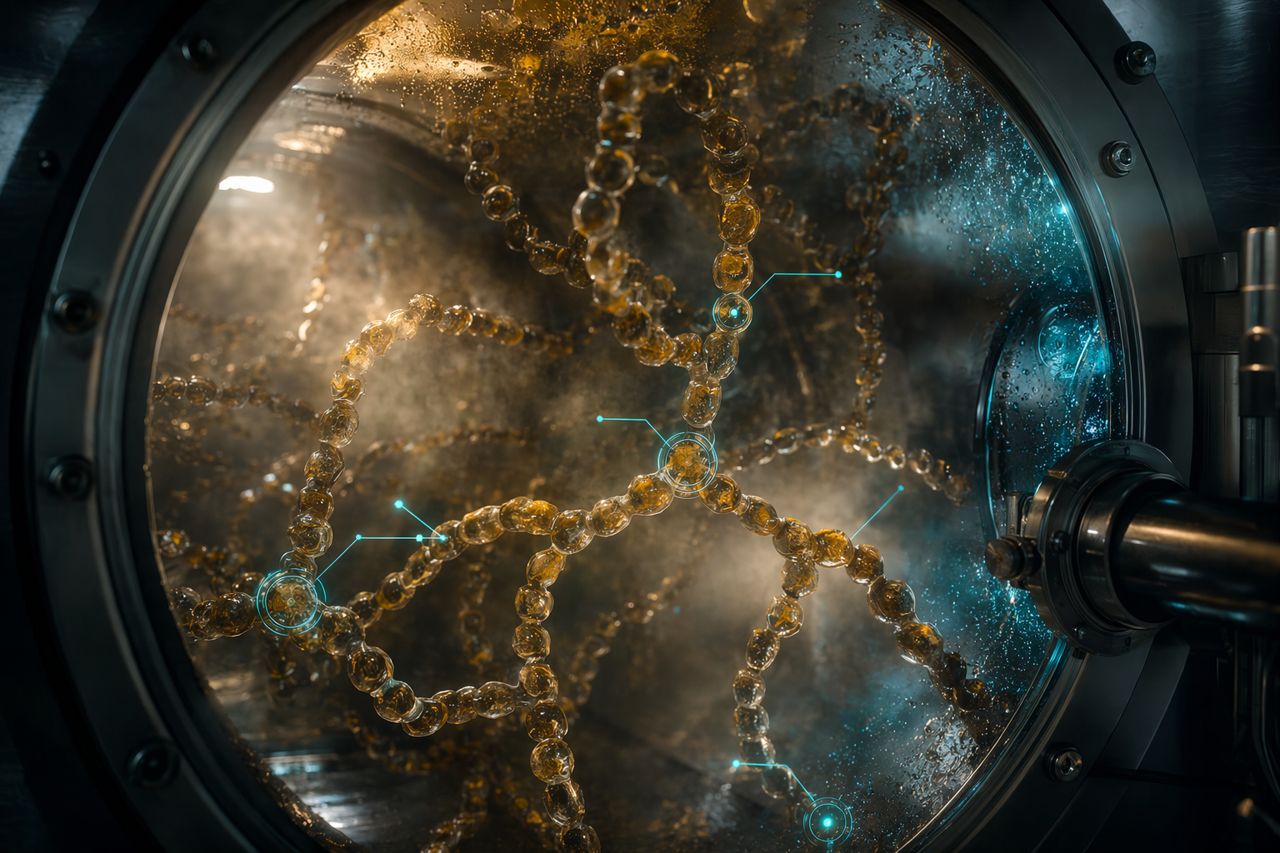
Amylopectin is not a simple linear glucose polymer. It contains branched architecture. Standard saccharification can remove glucose from accessible ends, but alpha-1,6 branch points create limit dextrins that are harder to finish.

Pullulanase cuts those alpha-1,6 linkages. The result is a simpler dextrin structure with more linear chains and more accessible ends for glucoamylase.
That change can support:
- More complete starch utilization by reducing inaccessible branched residues.
- Faster approach to glucose-rich syrup targets when process conditions are aligned.
- Lower residual oligosaccharide load in the finished syrup profile.
- Improved saccharification consistency across feedstock or liquefaction variation.
- Better downstream predictability for filtration, evaporation, fermentation, and dextrose crystallization operations.
Commercial reasons to specify pullulanase
Pullulanase is not added because it sounds technically elegant. It is specified when debranching improves the economics or control of the syrup plant.
Higher conversion potential
By exposing branch-limited dextrins, pullulanase helps the saccharification system move closer to high-glucose targets. For dextrose syrup and crystallization feed, that can mean a cleaner carbohydrate profile and a more disciplined route to specification.
Better use of saccharifying enzymes
Pullulanase does not replace the main saccharifying enzyme. It makes the substrate more available. In many process designs, this supports better utilization of the glucoamylase package and reduces the drag caused by branched limit dextrins.

Reduced process variability
Feedstock quality, liquefaction profile, and residence time all influence saccharification. Debranching gives the process an additional control point, especially when residual branched dextrins are limiting final glucose formation.
Cleaner downstream behavior
Syrup composition affects filtration, evaporation, fermentation kinetics, crystallization behavior, and finished product consistency. Pullulanase supports a more predictable carbohydrate spectrum when debranching is the bottleneck.
Application targets
Pullulanase is relevant for several glucose and dextrose syrup streams:
- High-glucose syrup production where starch conversion and residual dextrin reduction are key performance indicators.
- Dextrose syrup production where a cleaner glucose-rich profile supports downstream finishing.
- Crystalline dextrose feed preparation where carbohydrate consistency can affect crystallization control.
- Fermentation-grade dextrose where fermentable sugar availability and residual carbohydrate profile influence yield and process timing.
- Integrated starch refineries looking to standardize enzyme performance across multiple syrup grades.
Process variables that matter
A successful pullulanase program is not based on a generic dose recommendation. It is built around the plant window.
Key variables to review:
- Starch source and amylopectin content.
- Liquefaction endpoint and dextrin distribution.
- Saccharification pH and temperature profile.
- Residence time available for debranching.
- Dry solids and mixing conditions.
- Compatibility with glucoamylase and other process enzymes.
- Target glucose profile, dextrose equivalent, and residual oligosaccharide limits.
- Downstream requirements for filtration, evaporation, crystallization, or fermentation.
- Deactivation, cleaning, and handling requirements.
Pullulanase Enzyme Solutions can help map these variables to a suitable pullulanase format and commercial supply plan.
Procurement and qualification checklist
When qualifying pullulanase for glucose or dextrose syrup production, buyers should request more than a price line.
Recommended qualification items:
- Product specification and physical format.
- Recommended storage and handling conditions.
- Compatibility guidance for the intended saccharification system.
- Documentation for quality, safety, and regulatory review.
- Lot traceability and certificate documentation.
- Sample availability for plant-relevant evaluation.
- Lead time, pack size, and continuity-of-supply discussion.
- Technical support for trial design and result interpretation.
What to measure during evaluation
Pullulanase performance should be judged against commercial process objectives, not only bench observations.
Useful plant or pilot indicators include:
- Time to reach the target glucose profile.
- Residual branched dextrin or oligosaccharide trend.
- Final syrup carbohydrate spectrum.
- Filtration behavior and clarity observations.
- Fermentation response where syrup is used as a fermentable feed.
- Crystallization consistency where syrup feeds dextrose production.
- Enzyme cost contribution relative to conversion gain and process stability.
What syrup plants report when pullulanase is added

Pullulanase is the enzyme that opens the conversion bottleneck of branched starch. Until the alpha-1,6 branch points are removed, hydrolysis cannot run to completion, and that is the step that lifts glucose and maltose yield. In one plant example, the glucose syrup reached a DX of 96.08%.
The gains reported go beyond the headline number: fewer residual sugars of DP3 and above, a shorter saccharification time and a lower glucoamylase dose for the same result. On a high-maltose line, the benefit shows up as a better maltose yield. Working conditions are plant-specific: the right window depends on the application and on the companion enzyme.
| What a syrup buyer measures | What the reported trials show |
|---|---|
| Glucose content of the syrup (DX) | Higher DX; one example reached 96.08% |
| Residual DP3+ sugars | Lower |
| Saccharification time | Shorter |
| Glucoamylase use | Lower dose needed |
| High-maltose syrup | Better maltose yield |
How to set up a plant trial that a purchasing decision can rest on:
- Monitor high-glucose and high-maltose runs against separate indicator lists, because each target profile needs its own measures.
- Do not judge the trial on DX alone; record DP3+ residuals and saccharification time as well.
- Do not copy another plant's pH and temperature; the window shifts with the application and the companion enzyme.
- Price the trial on the whole enzyme package, since a lower glucoamylase dose is part of the return.
Ready for a quote? Use the inquiry form at the foot of this page. Tell us the application, the quantity, your preferred pack and the delivery country; price, available documents and lead time are quoted per order.
Request pricing for pullulanase
If you are sourcing pullulanase for glucose syrup, dextrose syrup, or fermentation-grade dextrose production, send the process context and purchasing requirement. Pullulanase Enzyme Solutions will review the application and respond with a practical supply path.